
General Meeting Report
Crime Prevention Seeks To Replace Rapid Response
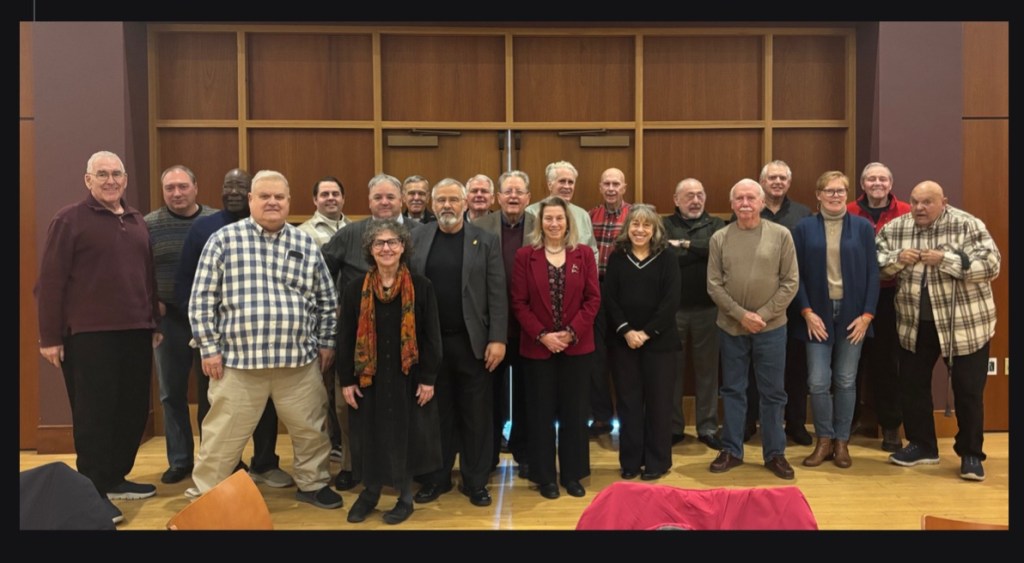
Over twenty-two members and guests assembled at MAPLE’s fall general membership meeting this December to hear former Boston Police Planner Jim Jordan share his thoughts and insights on the direction that policing is moving. The meeting was held at the Martin Institute at Stonehill College in Easton MA. There was good food and fellowship as members reconnected in their shared concern for better policing in this Commonwealth.
Jordan told the members, that there is a transition occurring in policing. There is a move away from the traditional rapid response model toward crime prevention. He drew on the experiences of the audience, asking, how many times members had responded to the same locations, encountering the same people and ending up with same result, arresting them again and again. The new approach, advocated by researcher Herman Goldstein, is to examine the conditions, that are causing the repeated calls and develop a strategy to pre-empt the recurring outcomes. This may mean working with probation officers, social services or local community services and institutions to see if strategies and tactics can be developed and applied to these recurring problems in order to prevent them.
This approach, Jordan said, will require new thinking by police officers and their leadership. Police officers will have to develop problem-solving skills and be given the latitude to address these situations. Rather than solely providing top-down direction, police supervisors and managers will be cast in new roles as facilitators, offering guidance, support and resources to their officers in their efforts to address recurring problems. The old hierarchal pyramid so typical of policing will need to collapse to a certain extent, so that this change can occur. A significant transition, will be require, true professional leadership will be needed, which remains a long way from full development. Education will be a critical element, in ensuring the success of this transition.
Members Frank Ardita and Bob Murphy along with guest Marty Driggs related their experiences in a sit-down with representatives of the state’s POST commission, they recently participated in. Concerns over recent events involving the conduct of trainers at municipal training academies were the focus of the discussion. Frank, Bob and Marty shared their many years of experience as successful MSP trainers. Frank shared his knowledge of the history of the MPTC dating back to the days of Gary Eagan. During the discussion it was disclosed that the MPTC retains very little control over the training cadre at municipal academies. Many of the trainers are selected by local chiefs. The recommendation from the MAPLE delegation to POST was clear, the MPTC must have full control over the selection of trainers and the trainers must be required to attend training themselves, to ensure that they are qualified to discharge these very critical duties.
In other business President Galvin provided an update on MAPLE’s legislative initiate that seeks to institute a 60 college credit minimum educational requirement for eligibility for appointment as a police officer in the state. Galvin stated that the following legislators have the proposal in hand; Senators Cronin, Brownsberger and Tarr , along with state representatives Holmes and Lombardo. The President is currently in discussion with the staffs of these legislatures with regard to the mechanics of filing the bill. It is MAPLE’s intent to have this bill on the 2026 legislative agenda. Finally, Treasurer Bill Rose reported that MAPLE’s Treasury was now at 6.9K.
 MAPLE
MAPLE 